Construction cost leakage: 10 ways your project is losing money, and how to prevent it
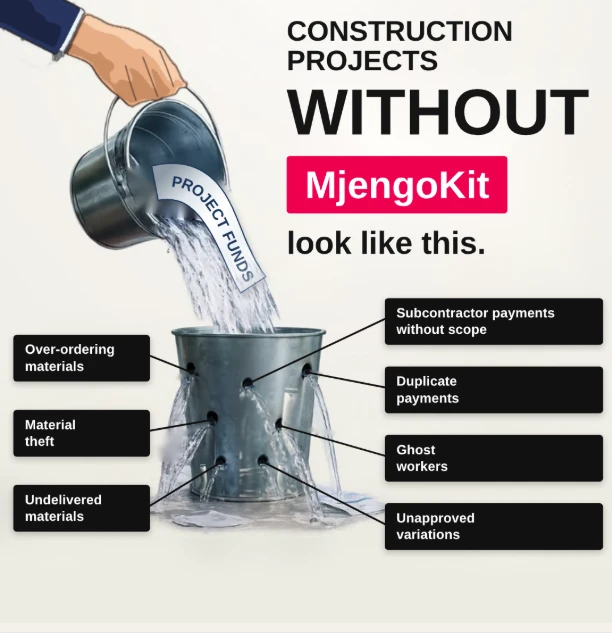
Construction cost leakage is the loss of project money, materials, labour value or other resources through poor controls, inefficiency, fraud, wastage, unplanned spending or weak financial oversight. It rarely arrives as one big loss. It builds up through small, repeated losses that go unnoticed until they show up in the project's profit.
Key takeaways
- Most leakage comes from everyday process gaps, not theft: purchases nobody checked, attendance nobody confirmed, payments made before the work was measured.
- Follow each item through every step: requested, approved, ordered, delivered, paid. Every gap between two numbers is a question to ask.
- Prevention stops a leak from starting. Detection catches the ones that get through. Corrective action recovers what it can and fixes the cause.
- Track what you have committed to pay and what you still owe, not only what you have paid.
- Review each project every week, not at month-end.
What construction cost leakage looks like
Picture a contractor running three sites at once: an apartment block in Kitengela, a maisonette in Ruiru and a shop fit-out in Westlands. Every day the foremen send requests for cement, sand and steel. Casual workers are paid by M-Pesa on Saturday. A plumbing subcontractor sends a claim for his second instalment. A hardware supplier delivers ballast and leaves an invoice.
Money leaves the business all week. At month-end the bank and M-Pesa statements are full of payments, but nobody can say with confidence which project each one belongs to, whether it was needed, or whether the projects are still within budget.
That is construction cost leakage seen from the director's chair. It is rarely one dramatic theft. It is ten extra bags here, two absent workers paid there, and a subcontractor paid for work that isn't finished yet. Each one is easy to miss. Together they eat the margin.
Cost leakage is not the same as a cost overrun
A cost overrun is an outcome: the project ended up costing more than its budget. Cost leakage is one of the causes: avoidable or poorly controlled losses along the way. You find an overrun when the numbers come in. You can find leakage week by week, if you look for it.
| Cost overrun | Cost leakage | |
|---|---|---|
| What it is | Actual cost ends up above the budget | Avoidable losses that push the cost up |
| When you see it | At the end of a stage or the project | Day to day, in your records and on site |
| Example | The structure cost more than the estimate | Paying for 200 bags of cement when 185 arrived |
| Can it be avoided? | Partly. Some overruns come from honest causes, such as price rises or extra work the client agreed to pay for | Mostly, with the right controls |
Fraud, inefficiency and overruns are different problems
Fraud is deliberate: a storekeeper selling cement, or a foreman adding names to the payroll. Inefficiency is nobody's intention: cement spoiled in the rain, workers waiting for materials, a second order placed because nobody knew stock was on site. An overrun is the result, and it can come from either, or from honest causes such as design changes and price rises.
Most leakage on construction sites is the second kind. But weak process is also where the first kind hides. Fixing the process deals with most honest mistakes and makes dishonest ones easier to see.
Why catching it early matters
A leak found in week two can be stopped with a phone call: recount the delivery, correct the wage sheet, hold the claim until the work is measured. The same leak found at the end of the project has been paid many times over, and the money is usually gone. Early detection also protects relationships, because it is easier to settle a short delivery on the day than to dispute an invoice months later.
The ten leaks at a glance
| Leak | A typical warning sign | The first control to put in place |
|---|---|---|
| 1. Materials | Material spending runs ahead of the work done | Check requests against estimated quantities |
| 2. Casual labour | The payroll is bigger than the headcount on site | Daily attendance confirmed by a supervisor |
| 3. Subcontractors | Payments run ahead of measured progress | Measure the work before certifying a claim |
| 4. Procurement | One supplier always wins, with no recent quotes | Quotes and approval limits for larger buys |
| 5. Payments | Payments you can't link to a request | No approved request, no payment |
| 6. Budgeting | Budget versus actual reviewed only at month-end | Weekly review of spending plus commitments |
| 7. Equipment | Hire invoices that don't match your site logs | Daily equipment and fuel logs |
| 8. Rework | The same task paid for twice | Inspections before work is covered up |
| 9. Overheads | Petty cash rising, receipts thinning | A fixed float topped up against receipts |
| 10. Delays | Gangs on site with little to show for it | A two-week look-ahead of materials |
Each section below covers how the leak happens, how the money is lost, the warning signs, how to prevent it, how to catch it early, what to monitor, and a short example from site.
1. Material leakage and wastage
Materials are usually the biggest share of a building budget and involve the most transactions, which makes them the easiest place for money to slip away. Material leakage covers every way a project pays for materials it didn't need, didn't receive or didn't use on its own work. It happens between the request and the store: in how much is ordered, what is signed for at the gate, how it is stored and who takes it out.
How the money is lost
- Ordering more than the stage needs, and leaving surplus on site when it ends.
- Paying for materials that never arrived, or for 200 bags when 185 came off the lorry.
- Theft from the store, and materials diverted to another project or a private job without authorisation.
- Poor storage: cement left in the rain, steel rusting in the open, tiles cracked in handling.
- Heavy cutting waste, such as steel cut without a cutting schedule.
- Inflated supplier prices, and duplicate purchases because nobody knew the stock was already on site.
- Materials issued from the store with no record of where they went.
Warning signs
- Material spending runs ahead of the work done on site.
- Frequent "urgent" top-up orders late in a stage.
- Invoices that don't match the LPO or the delivery note.
- Nobody can give you today's stock of cement, steel or sand.
- The same items bought for two sites in the same week.
Prevent it
- Check every material request against the estimated quantities for that stage, from your bill of quantities or take-off.
- Issue an LPO for every purchase, with quantity, rate and delivery site.
- Count deliveries at the gate against the LPO. Sign the delivery note or goods received note for what actually arrived.
- Store materials raised, covered and locked.
- Record every issue from the store against the work it was used for.
Detect it early
- Match three documents before paying: the LPO, the signed delivery note and the invoice.
- Reconcile stock weekly: opening stock plus deliveries, minus issues, should equal what is in the store.
- Compare materials used with work done, such as bags of cement per cubic metre of concrete placed.
- Requested220
- Approved20020 over the estimate, stopped at approval
- Ordered200
- Delivered185
- Paid20015 bags paid for but never delivered
What to monitor
- Quantities requested against the estimate, for each stage.
- Quantities ordered, delivered and paid, for each supplier.
- Stock on hand for high-value items.
- Unit prices by supplier over time.

The 15 missing bags. A site in Ruiru orders 200 bags of cement at KES 790. The lorry brings 185, the driver says the rest will come tomorrow, and the foreman signs for 200 to save time. The invoice for KES 158,000 is paid in full. The balance never arrives.
The fix: the storekeeper signs only for what is counted, and finance pays against the signed quantity: KES 146,150 for 185 bags. The balance is paid when it arrives.
More on this: controlling material purchasing, preventing material theft on site and matching the requisition, LPO and invoice.
2. Labour and casual wages leakage
Casual labour is paid often, in small amounts, usually by M-Pesa or cash at the end of the week. When the muster roll is kept by one person and nobody checks it against who is actually on site, the wage bill can become one of the biggest leaks on a project.
How the money is lost
- Ghost workers: names on the payroll who are not on site.
- Paying workers who were absent, or who have already left the project.
- Attendance padded with extra days or hours.
- Daily rates above the agreed rate for the trade.
- Overtime nobody approved, and hours paid that weren't worked.
- Paying the same worker twice in one week, under two names or two numbers.
- Mistakes in the wage calculations.
Warning signs
- The payroll is bigger than the headcount you see on visits.
- Several names paid to the same M-Pesa number.
- Wages rise while progress stays flat.
- The same few names have overtime every week.
- One person both records attendance and approves the payroll.
Payroll fraud or a productivity problem?
Not every high wage bill is fraud. If the names are real and the days were worked but output is low, the problem is productivity: workers waiting for materials, the wrong gang size, unclear instructions or weak supervision. That calls for better planning and supervision, not a payroll investigation. Accurate attendance is what lets you tell the two apart.
Prevent it
- Register every casual worker once, with their ID and their own M-Pesa number.
- Record attendance on site every day, confirmed by a supervisor.
- Agree rates per trade in writing, and approve overtime before it is worked.
- Keep duties apart: whoever records attendance doesn't approve the payroll or send the money.
- Pay each worker directly to their own number, not through a foreman.
Detect it early
- Reconcile every week: workers present, days worked, approved rate and amount paid.
- Make unannounced headcounts and compare them with that day's register.
- Look for repeated M-Pesa numbers, and for names that appear on more than one site.
| Weekly wage check | Compare | With |
|---|---|---|
| Who was there | Names on the payroll | The daily attendance register and spot headcounts |
| How long | Days and hours paid | Days and hours recorded and approved |
| At what rate | Rate paid | The agreed rate for the trade |
| To whom | Amounts sent by M-Pesa | Net pay per worker, to their own number |
What to monitor
- Wage cost per week for each project, against progress.
- Overtime hours by worker.
- Headcount over time, and payments per M-Pesa number.
Three extra names. A foreman in Kitengela sends a weekly wage sheet for 46 workers. On a Wednesday visit the project manager counts 41. The register shows 46 every day, and three of the names are paid to the same M-Pesa number.
The fix: every worker is registered with their own number, the site supervisor confirms attendance daily, and the project manager approves the payroll before anyone is paid.
More on this: spotting ghost workers, a free construction attendance sheet and paying casual workers in Kenya.
3. Subcontractor leakage
Subcontractors carry out large, specialised parts of the job: plumbing, electrical, roofing, aluminium and glass, painting. Their payments are bigger and less frequent than wages, so a single overpayment matters. Most subcontractor leakage comes from paying before the work has been measured against an agreed scope.
How the money is lost
- Paying without a written, approved scope of work and agreed rates.
- Paying for work that isn't finished, against an optimistic progress claim.
- Inflated quantities, or claims for work outside the agreed scope.
- The same claim paid twice, or a claim that repeats work already paid for.
- Extra work done without an approved variation, then claimed.
- Charging for materials the main contractor supplied.
- Poor workmanship that has to be redone at the main contractor's cost.
Warning signs
- Payments run ahead of measured progress.
- Claims arrive without measurements or a breakdown.
- "Extras" appear on most claims.
- Nobody can tell you the contract sum, the amount paid to date and the balance.
- Defects keep appearing after the subcontractor was paid.
Prevent it
- Agree a written scope, drawings, specification, rates and payment schedule before work starts.
- Tie payments to measurable milestones, such as "first fix complete on floors 1 to 3".
- Approve variations in writing, with a price, before the extra work is done.
- Record the materials you supply, so they can't be charged again.
- Hold a retention until defects are fixed, if the contract allows it.
Detect it early
- Measure or inspect the work on site before certifying each claim.
- Keep a running account for each subcontract: contract sum, approved variations, certified to date, paid to date and balance.
- Check each new claim against earlier ones for repeated items.
What to monitor
- Paid to date against certified progress, for each subcontractor.
- The variations register: requested, approved and priced.
- Retention held and the outstanding balance.
The roof that was "80% done". A roofing subcontractor claims 80% of a KES 1.2 million contract. The site engineer measures before certifying: iron sheets are fixed on two of three blocks, and the third has trusses only. That is about 60% of the work.
The fix: the claim is certified at 60%, and the difference of KES 240,000 is paid when the work is done.
More on this: managing subcontractor payments.
4. Procurement and purchasing leakage
Procurement leakage happens before anything is delivered: in how suppliers are chosen, which prices are agreed and who is allowed to buy. It is where inflated prices, favouritism and collusion between staff and suppliers hide most easily, because each single purchase looks reasonable.
How the money is lost
- Buying without comparing quotes, so prices drift up.
- One supplier always "wins", at prices above other quotes, sometimes with a kickback to whoever chose them.
- Purchases split into smaller amounts to stay under an approval limit.
- Purchases nobody approved, and duplicate LPOs for the same need.
- Emergency purchases at premium prices, from poor planning.
- Paying suppliers before the delivery has been checked.
- Weak negotiation: no volume discounts, credit terms or fixed prices on large orders.
Warning signs
- One supplier gets most of the business, with no recent comparison.
- Unit prices above recent quotes.
- Many purchases just below the approval limit.
- Frequent urgent orders and same-day payments.
- The same person requests, picks the supplier, receives the goods and approves the payment.
Prevent it
- Keep a register of approved suppliers, with their contacts and payment details.
- Get at least three quotes above a set amount, and keep them on file.
- Set approval limits, and treat split purchases as one purchase.
- Separate duties: requesting, approving, receiving and paying should be different people.
- Plan purchases from the programme, so fewer orders are emergencies.
Detect it early
- Compare unit prices by supplier, and over time, for your most-bought items.
- Review purchases just under approval limits, and repeated small buys from one supplier.
- Question any payment to a supplier who isn't on the register.
What to monitor
- Unit prices for your key materials.
- Each supplier's share of your spending.
- The number of emergency purchases, and purchases without an LPO.
The steel price nobody checked. For six months a project buys Y12 bars from one supplier, ordered and approved by the same site manager. When the director asks for quotes, two other suppliers come in at KES 1,060 and KES 1,080 a bar against the KES 1,150 being paid.
The fix: three quotes for any order above a set amount, approval by someone other than the buyer, and a monthly price check on the ten most-bought items.
More on this: a purchase approval process and preventing unauthorised spending.
5. Payment and financial control leakage
Every leak in this guide ends with a payment. That makes payment controls the last line of defence: the point where a wrong, duplicate or unapproved payment can still be stopped. With M-Pesa, bank transfers and cash all in use on site, money can leave in minutes.
How the money is lost
- Payments made without an approved request.
- The same invoice paid twice, such as once by bank and once by M-Pesa.
- Money sent to a wrong or changed account or number.
- Payments above the approved amount.
- Cash withdrawn and spent with no record of what for.
- Payments with no invoice, delivery note or receipt behind them.
- Advances to staff and subcontractors that are never recovered.
- Losing track of what is still owed, which leads to double payments or late-payment charges.
A controlled payment workflow
- RequestWhat, for which project, how much, with the quote or claim attached.
- ReviewChecked against the budget, the estimate or the contract.
- ApproveApproved by the person with authority for that amount.
- PayThe approved amount, to the payee's recorded account or number.
- RecordThe payment reference saved against the request, and the balance updated.
For every project, keep four numbers apart: what has been requested, what has been approved, what has actually been paid and what is still owed. Mixing them up is how payments get made twice, or approved commitments get forgotten until the supplier calls.
Warning signs
- Payments you can't link to a request or an invoice.
- The same amount to the same payee twice within days.
- A supplier's bank details "changed" by phone or WhatsApp.
- Growing cash withdrawals with thin records.
- Advances that stay open for months.
Prevent it
- No approved request, no payment.
- Approval limits by amount, and two people on every payment: one approves, one pays.
- Pay only to accounts and numbers already on record. Confirm any change by calling a contact you already know.
- Check the name M-Pesa shows before you confirm a payment. Safaricom's Hakikisha feature shows the registered name first.
- Keep the request, approval, invoice and delivery note with every payment. Ask suppliers for eTIMS invoices, which KRA uses to validate the expenses businesses claim.
- Record advances, and recover them from the next payment.
Detect it early
- Reconcile bank and M-Pesa statements with your recorded payments every week.
- Look for duplicates: same payee, same amount, close dates.
- Keep an outstanding payments register and review it weekly.
- If money goes to the wrong M-Pesa number, ask Safaricom for a reversal straight away.
What to monitor
- Requested, approved, paid and owed, for each project.
- Transactions not yet matched to a request.
- Open advances, and cash spent.
The invoice paid twice. A supplier's invoice for KES 248,000 is paid by bank transfer on Monday. On Thursday the supplier's rider brings a copy to site, and the site manager, who doesn't know it was paid, sends KES 248,000 by Paybill.
The fix: every payment is recorded against its request and invoice number, so a second payment against the same invoice shows up before it is sent, and statements are reconciled weekly.
More on this: tracking outstanding payments, using M-Pesa for construction payments and reconciling construction expenses.
6. Project budgeting and planning leakage
Some money is lost before the first block is laid: in an estimate that was too low, a budget that is never compared with actual spending, or a scope change that nobody priced. Budgeting leakage is less visible than theft, but it often explains why a project that "looked fine" ended in a loss.
How the money is lost
- Underestimating material quantities or labour in the original estimate.
- Costs booked to the wrong project, hiding one project's overrun in another.
- Unplanned spending that was never in the budget.
- Scope changes agreed on site without a budget adjustment, or without a variation to the client.
- Poor scheduling that leaves workers and equipment idle.
- Starting work before materials, labour and cash are confirmed.
- Supplier price rises that the budget never caught up with.
Paid is not the same as spent
Looking only at what has been paid gives a false picture. You also need committed costs: amounts you have agreed to pay but haven't paid yet, such as approved requests, issued LPOs and certified subcontractor claims. The remaining budget is the budget minus what is paid and what is committed.
Warning signs
- Budget against actual reviewed only at month-end, or never.
- Costs coded to "general", or to whichever project has budget left.
- Variations on site with no written instruction from the client.
- A stage's budget used up before the stage is finished.
Prevent it
- Build the budget from quantities: materials, labour and subcontracts for each stage or work package.
- Split the budget by project and milestone, and code every cost to one of them.
- Price and approve variations before the work, and agree them with the client.
- Plan materials and labour against the programme, and update prices in the estimate at each stage.
Detect it early
- Review budget, paid and committed for every project, every week.
- Flag any stage that has used most of its budget before most of its work.
- Compare what is left in the budget with the work still to do.
What to monitor
- Budget, committed, paid, owed and remaining, for each milestone.
- The variations register, and the forecast cost to complete.
The slab that "stayed within budget". Payments for a ground-floor slab total KES 7.8 million against a KES 10 million budget, so the site reports it is on track. But approved LPOs for steel and formwork worth KES 1.9 million are still unpaid, and the concrete for the last bay hasn't been ordered.
The fix: the weekly review shows only KES 0.3 million left. The project manager prices the extra columns the client asked for as a variation before the last pour, instead of absorbing them.
More on this: a weekly construction cost review and how to control construction costs.
7. Equipment and machinery leakage
Equipment costs money whether it is working or not: hire charges by the day or hour, fuel, operators and repairs. Leakage here comes from paying for hours, fuel and machines the project didn't need or didn't use.
How the money is lost
- Theft of tools and small equipment, and fuel siphoned from machines or the site store.
- Fuel use higher than the work done would explain.
- Machines used for other jobs without authorisation.
- Paying hire for idle days, or hiring equipment the job doesn't need.
- Hire hours inflated on time sheets, or the same hire invoiced twice.
- Breakdowns from poor maintenance, with repairs and downtime.
Warning signs
- Fuel bought every day but no running log.
- Hire invoices that don't match your own site records.
- Hired machines that rarely move.
- The same machine breaking down again and again.
Prevent it
- Keep an equipment register of owned and hired items, with location and condition.
- Agree hire terms in writing: rate, minimum hours, standby rate and who supplies fuel.
- Log daily use: hour-meter readings, operator and task. Issue fuel against the log, from a locked store.
- Off-hire equipment as soon as the work ends, and confirm the date in writing.
Detect it early
- Compare hire invoices with your own daily logs before paying.
- Track fuel per hour or per load for each machine, and look for jumps.
- Review weekly which hired machines worked and which stood idle.
What to monitor
- Hire days paid against days worked.
- Fuel used per machine, and idle days.
- Maintenance due and breakdowns.
The excavator that stayed a week too long. An excavator hired for foundation excavation finishes on a Tuesday but stays on site until the following Monday, because nobody called the hire company. The extra days are charged at the standby rate.
The fix: the site manager confirms off-hire in writing on the day the work ends, and every hire invoice is checked against the daily log before it is paid.
8. Quality and rework leakage
Rework means paying twice for the same work: once to build it wrong, and again to break it out and rebuild it. It rarely shows as a line in the accounts, because the cost is spread across materials, labour and time.
How the money is lost
- Poor workmanship that has to be broken out and redone.
- Materials of the wrong specification, such as the wrong class of concrete or block.
- Work that doesn't follow the approved drawings.
- Weak supervision and the wrong construction methods.
- Poor-quality materials that fail and must be replaced.
- Defects found only after the next stage has covered them, such as leaking pipes behind finished walls.
Warning signs
- The same task appears twice in labour or subcontract records.
- Snag lists that grow at each inspection.
- Materials ordered again for work that was already done.
- Inspections skipped to keep to the programme.
Prevent it
- Check materials against the specification when they arrive.
- Inspect at hold points, before work is covered: reinforcement before casting, plumbing before plastering, waterproofing before tiling.
- Brief fundis and subcontractors on the drawings and the standard expected before they start.
- Approve each stage before paying for it.
Detect it early
- Keep a defects register, with the cost of each fix and who pays for it.
- Test where it matters, such as concrete cubes and pressure tests on pipes.
- Recover rework costs from the subcontractor responsible, where the contract allows.
What to monitor
- The number and cost of defects, by trade or subcontractor.
- Inspections done against inspections planned.
The pipes behind the tiles. Bathroom walls are tiled before the plumbing is pressure-tested. Two weeks later a joint leaks, and the tiles on four walls are broken out to reach it. Tiles, adhesive and tiling labour are paid for twice.
The fix: no plastering or tiling until the plumbing passes a pressure test signed off by the site engineer.
9. Site operations and overhead leakage
Overheads are the many small costs of running a site: petty cash, transport, vehicle fuel, airtime, tools, consumables, security, water and power. Each one is small, which is exactly why they leak.
How the money is lost
- Petty cash topped up without receipts, and a float that keeps growing.
- Site allowances paid more generously than agreed.
- Transport and fuel for trips that weren't project business.
- Inflated accommodation and travel claims.
- Utility and service bills paid twice, or charged to the wrong site.
- Tools and consumables bought without approval, and bought again because they went missing.
- Vehicle and equipment trips that better coordination would have avoided.
Warning signs
- Petty cash rising month on month, with thin receipts.
- Expenses coded "miscellaneous" or "general".
- Fuel claims that don't match the vehicle log.
- The same bill paid from two projects.
Prevent it
- A fixed petty cash float for each site, topped up only against receipts.
- Clear limits and approval rules for site expenses.
- Vehicle logs for trips and fuel.
- Every expense coded to a project and a category.
Detect it early
- Count petty cash weekly and reconcile it with receipts.
- Review overheads by project and category every month, and look for drift.
- Compare fuel claims with the vehicle log.
When every site keeps its own notebook, overheads are invisible at company level. Recording site expenses in one place, by project and category, is what lets a director see that one site spends twice as much on transport as another of the same size.
What to monitor
- Petty cash spent at each site.
- Overheads as a share of each project's cost.
- Fuel per vehicle, and expenses with no project or category.
The float that kept growing. A site's petty cash starts at KES 20,000. Top-ups go out by M-Pesa whenever the foreman asks, without receipts. After three months the site has received KES 210,000 in top-ups, with receipts for about half.
The fix: a fixed KES 20,000 float, topped up weekly only to replace what the receipts show was spent.
More on this: site petty cash control and how to track construction expenses.
10. Time and project delay leakage
Delay leaks money even when nothing is stolen. Every extra week on site adds equipment hire, site staff salaries, security and the cost of money tied up in the project. Late completion can also trigger penalties under the contract.
How the money is lost
- Work stops because materials haven't arrived.
- Workers wait, and are paid, for materials, drawings or instructions.
- One subcontractor's delay holds up the trades that follow.
- Equipment breakdowns and downtime.
- Poor sequencing, so work is done out of order or redone.
- Hire, site staff, security and site office costs run on for longer.
- Penalties for missing the completion date.
Warning signs
- Progress behind the programme several weeks in a row.
- Gangs on site with little output.
- Nobody tracks lead times for key materials.
- Subcontractors starting late on most packages.
Prevent it
- A realistic programme, with the critical activities marked.
- Purchases planned from the programme, allowing for each material's lead time.
- A weekly meeting between site, purchasing, finance and subcontractors.
- Paying suppliers and subcontractors on time, so work doesn't stop.
Detect it early
- Compare progress with the programme every week.
- Track time-related costs per week: hire, staff and security.
- List materials needed in the next two weeks that aren't ordered yet.
What to monitor
- Progress against the programme, and days lost with the reason.
- Weekly time-related costs.
- Materials due against materials ordered.
The late steel. Reinforcement for a first-floor slab is ordered three days before it is needed, but the supplier needs a week. The formwork crew, the scaffold hire and the concrete pump booking all wait. Nothing was stolen, but a week of hire, wages and site costs bought no progress.
The fix: a two-week look-ahead of materials at the weekly site meeting, with orders placed against each supplier's lead time.
How to detect cost leakage before it becomes a major loss
Month-end accounts tell you what happened. By then most leaks have been paid. An early-warning system works the other way: it compares figures that should agree, every week, and shows the gaps while you can still act on them.
| Compare | With | A gap may mean |
|---|---|---|
| Material quantities requested | Estimated and approved quantities | Over-ordering, or an estimate that was too low |
| Materials ordered | Materials delivered | Short deliveries, or deliveries still due |
| Materials delivered | Materials paid for | Paying for goods that never arrived |
| Labour attendance | Wages paid | Ghost workers, padded days or wrong rates |
| Subcontractor payments | Work verified on site | Paying ahead of progress |
| Spending requested | Spending approved | Requests being trimmed, or spending that skips approval |
| Spending approved | Actual payments | Overpayments, or commitments still to pay |
| The budget | Spending plus commitments | A stage heading for an overrun |
| Supplier invoices | The outstanding payments register | Duplicates, or late-payment charges on the way |
| Variations built on site | Variations approved | Extra work that won't be paid for |
| Expense claims | Earlier claims | Repeated or unusual claims |
Turning comparisons into action
- Review every project every week, with the same comparisons each time.
- Show the exceptions, not every line, to the people who control the money: the director, the project manager and finance.
- Investigate before you conclude: ask, recount, check the documents. Many gaps have honest explanations, such as a delivery still on its way.
- Correct and recover: hold or adjust the payment, recover the overpayment, fix the process that let it through.
- Record what you found, so repeat patterns stand out.
The three kinds of control work together. Prevention stops a leak from starting. Detection finds the leaks that got through. Corrective action recovers what it can and fixes the cause, so the same leak doesn't come back.
Building a construction financial control system
You don't need a finance department to control site spending. You need a small set of controls that every project follows:
- A clear project budget, split by milestone or work package.
- Defined material and labour requirements for each stage, from the estimate.
- One requisition process for every site and every type of spending.
- Written approval rules: who approves what, up to which amount.
- Verified suppliers and subcontractors, with agreed rates and recorded payment details.
- Verified delivery and completed work before payment.
- Controlled payments: approved payee, approved amount, recorded reference.
- Accurate attendance and wage records.
- All site expenses tracked in one place, by project and category.
- A regular financial review of every project.
These controls form a chain. The budget sets what is allowed. The requisition asks for it. Approval decides. Verification confirms what arrived or was built. Payment pays the verified amount, and the record and the weekly review show the gaps. Break one link, such as paying without verification, and the rest can't catch what slips through.
Financial control isn't about saying no. It is about making sure every shilling spent is justified, authorised, traceable and tied to something the project actually needs.
Five controls you can start this week
- No LPO or approved request, no payment.
- A second person approves every request.
- Casual workers paid to their own registered numbers.
- Bank and M-Pesa statements reconciled every Friday.
- One list of what you owe, across all projects.
Where MjengoKit fits
Notebooks, spreadsheets and WhatsApp can run these controls on one site. Across several sites they become hard to keep up, which is where most controls quietly lapse. MjengoKit is construction payments and spend control software for contractors and developers. It puts the request, approval and payment steps from this guide on one record:
- Requisitions for materials, casual labour, subcontractors and overheads, each tied to a project and a milestone.
- Approvals level by level, from a phone or a laptop, before anything is paid.
- LPOs from approved material requests, sent to suppliers on WhatsApp.
- Payments by M-Pesa, Till, Paybill or bank, confirmed with a one-time code, with part payments and outstanding balances recorded.
- Casual payroll built from attendance and overtime, approved before workers are paid by M-Pesa.
- Budgets by project and milestone, with spending tracked against them.
- One view across all your projects of what has been requested, approved, paid and is still owed, with an Excel export for your accountant or QS.
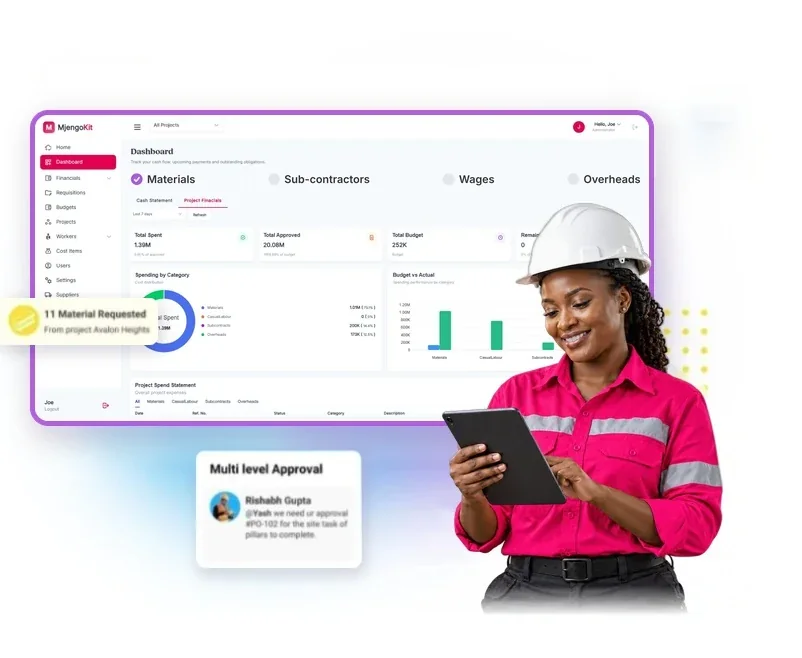
Software can't do everything in this guide. It can't count the bags that came off the lorry, check that a wall follows the drawing, notice a missing excavator or confirm that a worker on the payroll is standing on site. Those still need people: a storekeeper who counts, a supervisor who confirms attendance, an engineer who measures. What MjengoKit does is make sure every payment goes through a request and an approval, and keep the record that lets you compare what was requested, approved, paid and owed, so the gaps are easier to see.
See how MjengoKit helps contractors and developers manage requisitions, approvals, payments and project budgets in one place.
Book a 20-minute demoStopping construction cost leakage
Construction cost leakage doesn't always happen through theft. It happens through everyday purchasing decisions, padded labour records, subcontractors paid ahead of their work, poor planning and expenses nobody reviews. None of these is dramatic on its own. The answer isn't dramatic either: a request before every purchase, a second person to approve it, a count before every payment and a weekly look at the numbers that should agree. Start with the leaks most likely on your own sites, and build from there.